The everyday baseline
Does My Dog Need a Multivitamin? An Honest Answer
If your dog eats a complete and balanced food, they may not need one. Here is when a daily multivitamin actually makes sense, and what to look for.

Quick answer
If your dog eats a food labeled "complete and balanced" for their life stage, and eats all of it, they are likely getting the vitamins and minerals they need. A daily multivitamin makes the most sense when meals are homemade or raw, when your dog is a picky eater who leaves food behind, or when you want extras that food is not built around, like probiotics, omega oils and joint support. Check with your vet first, especially for puppies.
What "complete and balanced" actually means
In the US, dog foods that carry a "complete and balanced" nutritional adequacy statement are formulated to meet nutrient profiles set by AAFCO, the Association of American Feed Control Officials. Look for that statement in small print on the back or side of the bag. It tells you the food is designed to cover minimum requirements for a specific life stage: growth, adult maintenance or all life stages.
That is a real baseline, and it is the reason many veterinarians say a healthy dog on a complete commercial diet does not need a separate multivitamin. We agree, and we would rather tell you that up front.
Where gaps tend to show up
- Homemade and raw diets. A UC Davis study published in the Journal of the American Veterinary Medical Association analyzed 200 homemade dog food recipes and found 95% were short on at least one essential nutrient. More in our guide to homemade and raw diets.
- Picky eaters. "Complete" assumes your dog eats the full portion. A dog who regularly leaves half the bowl, or fills up on toppers, treats and table food, may not be eating the diet as designed.
- Extras food is not built around. Probiotics, omega-rich fish oil and glucosamine are not required for a food to be called complete, so many owners add them separately.
- Life stage changes. Growing puppies, very active dogs and seniors have different needs. Your vet can tell you whether your dog's current food still fits.
Can a multivitamin be too much?
Yes. More is not automatically better. Some nutrients, especially fat-soluble vitamins, can build up when a supplement is stacked on top of an already complete diet. That is why dosing by weight matters, and why it is smart to avoid giving several overlapping supplements at once. If you are unsure, bring the labels to your vet.
What to look for in a dog multivitamin
- A clear ingredient list with amounts per serving, not just a "proprietary blend"
- Dosing by your dog's weight
- A batch Certificate of Analysis (COA) you can actually see
- Made in a GMP-certified facility
- Few or no fillers, binders or added sugars
- A format your dog will happily eat every day
Where Puptein Multivitamin fits
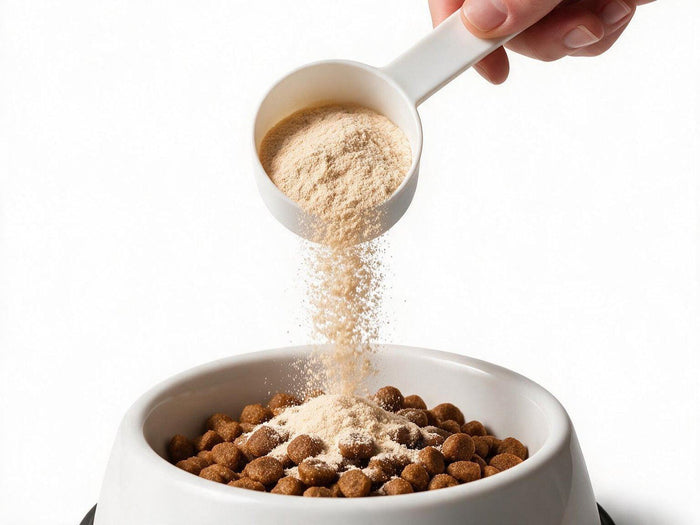
We built Puptein Multivitamin as an everyday baseline for owners who want the basics covered in one scoop. Each serving combines a B-vitamin and mineral complex with zinc and manganese, vitamins C and E, a six-strain probiotic blend (250M CFU), salmon oil and hemp seed oil, cranberry, and glucosamine with chondroitin. It is a beef-flavored powder you stir into wet or dry food, made without fillers or binders.
It helps support normal energy metabolism, immune health, digestion, healthy skin and coat, and joint function. Serving size is based on weight: 1 scoop for dogs up to 15 lb, 2 scoops for 16 to 30 lb, 3 scoops over 30 lb.
FAQ
Do vets recommend multivitamins for dogs?
For healthy dogs on a complete and balanced diet, many vets say a multivitamin is not necessary. They are more likely to suggest one for homemade diets, picky eaters or specific life stages. Ask yours about your dog.
Can I give my dog a human multivitamin?
No. Human vitamins are dosed for people and can contain ingredients that are not safe for dogs, such as xylitol in some chewable and gummy products. Stick to products made for dogs.
Can puppies take a multivitamin?
Puppies on a complete growth formula usually do not need one, and large-breed puppies are sensitive to excess minerals like calcium. Check with your vet before adding anything to a puppy's diet.
How long until I notice a difference?
Daily supplements work gradually. Give any new routine at least four to six weeks of consistent use before judging it.
This article is for general education and is not a substitute for advice from your veterinarian. These statements have not been evaluated by the Food and Drug Administration. Puptein products are not intended to diagnose, treat, cure or prevent any disease.